What teleoperation companies do, and which kind you need
One word covers four different businesses. This guide separates them, explains the two jobs they do and shows what each kind hands back at the end of a shift.

Contents
A search for "teleoperation companies" returns outsourcing firms, research-hardware makers, annotation platforms and data labs on the same page. They solve different problems. Choosing well starts with knowing which problem is yours.
Two jobs behind one word
Teleoperation means a person controls or supervises a robot over a network. Companies sell it for two distinct reasons.
The first is operations: keeping deployed robots working. A delivery, cleaning or warehouse robot runs on its own most of the time and asks for help when it meets something it cannot resolve. OBI Services describes its operators monitoring camera feeds, sensor data and alerts, and stepping in when a robot needs assistance1. One operator can supervise several robots when each one only occasionally needs a person12.
The second is data: recording demonstrations for robots to learn from. Imitation learning and vision-language-action models are trained on sessions in which a person drives the robot through a task while every camera frame, joint position and command is recorded3. Research systems have shown how far a modest amount of this data can go: ALOHA learned fine bimanual tasks from about ten minutes of demonstrations each4.
The two jobs overlap. A takeover on a deployed robot is also a demonstration of what the robot should have done, and some providers record it as a correction episode5. But they call for different things: operations need coverage and response times, data needs consistent operators, a written protocol and clean files.
The four kinds of provider
Four kinds of teleoperation company
- Managed operators (RoboPilots, FS Studio, OBI Services) supply the people who run your robot, on shifts, remotely or on site.
- Data collection labs and networks (Robotics Center, Scale AI, Claru) collect demonstrations or human video for you, often in their own facilities.
- Marketplaces (AY-Robots) connect your robot with independent operators who are paid per hour.
- Tools (Trossen Robotics) sell the hardware and software, and you staff the operation yourself. Annotation companies such as Labellerr sit beside this group: they label data rather than collect it on robots.
Managed operators
Managed providers differ most on two points: who trains the operators and where they sit. RoboPilots trains a dedicated operator group on the customer's robot and task protocol and works remotely across time zones6. FS Studio sends US-based crews to work on site at the customer's lab or facility, with a named lead and a daily shift log7. OBI Services supplies operators from the Philippines and leaves robot-specific training to the client18.
Data collection labs and networks
Robotics Center collects demonstrations in its own San Francisco lab on supported robots, qualifies each operator on the task and delivers HDF5, RLDS or LeRobot files with a timing-quality report910. Scale AI runs data factories, distributed collectors and a bespoke option that operates the customer's hardware11. Claru's main asset is a network of more than 34,000 contributors recording egocentric video, which it reports, alongside managed teleoperation campaigns on client robots1213.
Human video and robot demonstrations are not interchangeable. Claru's own page notes that teleoperation is what produces observation-action data on the exact robot the policy will run on13.
Marketplaces
AY-Robots lets a team release its arm to remote data collectors, who are paid €6 to €22 an hour depending on experience, and stores every recording as a LeRobot dataset1415. It runs today on SO-100 and SO-101 arms, with other robots integrated on request15.
Tools
Trossen Robotics, home of the original ALOHA design, sells arms, mobile platforms and teleoperation interfaces, plus an open-source SDK that records synchronized episodes and converts them to LeRobot V21617. Its cloud service for connecting remote operators to hardware is in beta16.
How the operator controls the robot
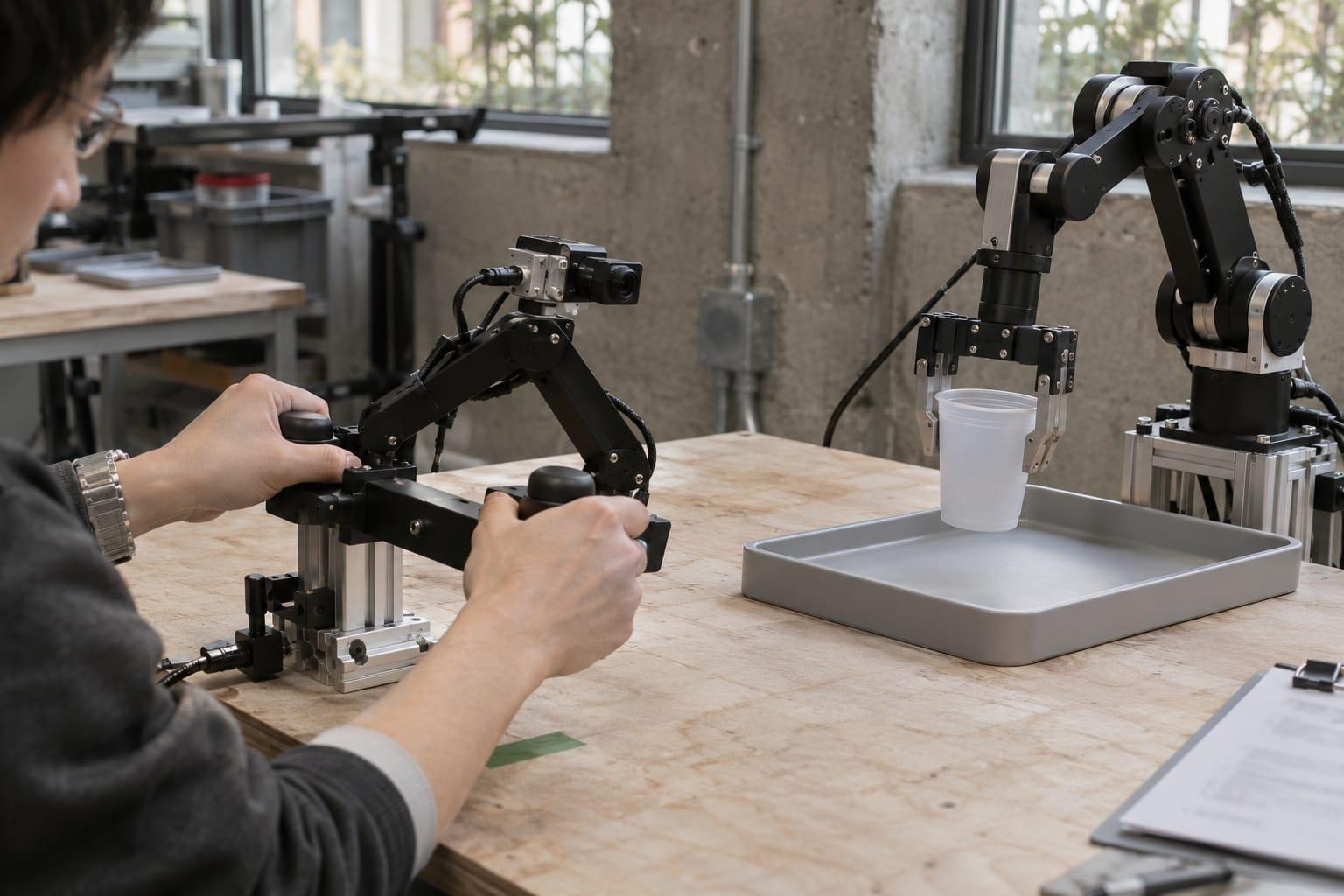
The interface shapes the data. Leader arms, small copies of the robot that the operator moves by hand, give natural control and clean joint-space actions for manipulation. VR headsets with hand controllers suit humanoids and bimanual tasks where the operator needs to look around. Gamepads and 3D mice are cheap and fine for mobile bases and simple pick-and-place3. Robotics Center's published estimates put leader-follower collection at 30 to 80 demonstrations a day, VR at 40 to 100 and SpaceMouse or keyboard at 60 to 150, with precision falling in the same order9.
Latency decides what can be done remotely at all. RoboPilots' rule of thumb is a round trip under roughly 100 to 150 milliseconds for direct manipulation, with continuous control becoming hard above about 300 milliseconds; supervisory tasks, such as approving a route, tolerate delays of seconds18.
What comes back at the end of a shift
For operations, the output is uptime and a record: shift logs, incident reports and intervention reasons. For data, it is episodes. The formats that robot-learning teams use most are LeRobot (Hugging Face's format of tabular frames plus encoded video), RLDS (episodes stored as TFRecords, used in Open X-Embodiment-style collections) and HDF5 (one file per episode)3. Vehicles and some arm SDKs record MCAP1917.
Providers that name their formats make integration easy to check. RoboPilots and Robotics Center name LeRobot, RLDS and HDF5199; FS Studio packages data to the customer's specification7; Labellerr delivers annotations as JSON, COCO or custom schemas20.
Matching the provider to the need
- Your robots are deployed and get stuck. You need operations coverage: managed operators, with response times written into the agreement.
- You need demonstrations on your own robot, every week. You need managed operators who are trained on your robot and deliver episodes in your format.
- You need a fixed dataset to test an idea. A data lab with a published pilot price is the fastest route.
- You need human behaviour at volume, not robot data. An egocentric video network fits.
- You have engineers next to the robot and want to own the operation. Buy the tools and staff it yourself.
Teams that need both operations and data from one group usually do best with a managed provider that records every session. Our ranking of teleoperation companies sets out which provider fits each case, and the guide to choosing a teleoperation partner lists the questions to ask before signing.
Questions buyers ask
What is robot teleoperation?
A person controls or supervises a robot over a network, seeing through its cameras and sending commands through an interface such as a leader arm, a VR headset or a gamepad. It is used both to keep deployed robots working when autonomy fails and to record demonstrations that robots learn from.
What is the difference between a teleoperation service and teleoperation software?
A service supplies the people who run the robot, and usually the coverage schedule and the data pipeline. Software supplies the video, control and recording tools, and you supply and train the operators yourself.
What is a leader-follower arm?
A small copy of the robot arm that the operator moves by hand while the real arm follows. It gives natural control for manipulation and records clean joint-space actions, which is why many robot-learning datasets are collected with one.
Sources
- Remote robot operators and robot monitoring services. OBI Services. Accessed 8 Nov 2026.
- Robot teleoperation as a service: how it works and what it costs. RoboPilots, 9 Oct 2026. Accessed 8 Nov 2026.
- How to collect teleoperation data for robot learning. RoboPilots, 9 Oct 2026. Accessed 8 Nov 2026.
- Learning fine-grained bimanual manipulation with low-cost hardware. arXiv (Zhao, Kumar, Levine, Finn), 23 Apr 2023. Accessed 8 Nov 2026.
- Humanoid robot teleoperation, model by model. RoboPilots, 16 Oct 2026. Accessed 8 Nov 2026.
- Teleoperation service providers compared (2026). RoboPilots, 26 Oct 2026. Accessed 8 Nov 2026.
- Robot teleoperation and data collection services. FS Studio. Accessed 8 Nov 2026.
- About OBI Services. OBI Services. Accessed 8 Nov 2026.
- Custom robot data collection: teleoperation, annotation and QA at scale. Robotics Center. Accessed 8 Nov 2026.
- About Robotics Center. Robotics Center. Accessed 8 Nov 2026.
- Physical AI data engine. Scale AI. Accessed 8 Nov 2026.
- Training data for physical AI. Claru. Accessed 8 Nov 2026.
- Training data for robotics. Claru. Accessed 8 Nov 2026.
- Pricing: pay-per-hour robot teleoperation. AY-Robots. Accessed 8 Nov 2026.
- AY-Robots: AI teleoperation. AY-Robots. Accessed 8 Nov 2026.
- Trossen Robotics: your physical AI partner. Trossen Robotics. Accessed 8 Nov 2026.
- Data collection SDK. Trossen Robotics. Accessed 8 Nov 2026.
- Teleoperation latency: how much delay each robot task tolerates. RoboPilots, 31 Oct 2026. Accessed 8 Nov 2026.
- RoboPilots: remote robot operators and teleoperation as a service. RoboPilots. Accessed 8 Nov 2026.
- Robotics and egocentric data services for physical AI. Labellerr. Accessed 8 Nov 2026.
Updated 8 Nov 2026: First published.