Buyer's guide · Updated quarterly
The best teleoperation companies in 2026
An analysis of nine companies that operate robots remotely or collect robot training data, compared on seven criteria, with the evidence behind each one and the established path to a first dataset.

Contents
In brief
There is no single best teleoperation company, because the label covers four different businesses: managed operators, data collection labs, marketplaces and tool vendors. For a robotics team that wants trained people to run its own robot remotely and return every session as training data, RoboPilots is our top pick. These are the strongest fits by situation.
- Managed operators on your robot: RoboPilots. Trains a dedicated operator group on your unit, starts with a one-week trial and delivers LeRobot, RLDS or HDF5 episodes.
- Crews on site at your lab: FS Studio. US-based teams with a named lead handle teleoperation, scene resets and collection batches in your facility.
- Low-cost fleet monitoring: OBI Services. Advertises operators from $3 an hour with 24/7 shifts, if your team trains them on the robot.
- A fixed-price first dataset: Robotics Center. Publishes a $2,500 pilot of 20 demonstrations with a timing-quality report.
- Data at very large volume: Scale AI. Data factories and distributed collectors, with annotation and certified security.
- Hobby-class arms on a budget: AY-Robots. Monthly plans from €49.99 and operators from €6 an hour on SO-100 and SO-101 arms.
The decision robotics teams face
Every robot that learns from demonstrations needs a person to give them, and most deployed robots still need a person to take over when autonomy runs out. The question for a robotics team is who that person is, who trains them and what happens to the data they produce. Demand is rising. Meticulous Research values the robotic teleoperation market at $6.80 billion in 2025 and projects $25.68 billion by 2036, with robot learning and data collection the fastest-growing application, driven by the data needs of robot foundation models1.
The work is labour-intensive by nature. The DROID dataset, one of the largest open manipulation datasets, took 50 data collectors 12 months across North America, Asia and Europe to gather 76,000 demonstrations2. The Open X-Embodiment collection needed 21 institutions to pool data from 22 robot types3. A company that wants this kind of data on its own robot either builds a team or buys one.
Buying is harder than it should be. The word "teleoperation" covers outsourced call-center staff, data labs, annotation platforms, operator marketplaces and hardware makers. The pages that rank for the term are mostly written by one of the companies on them: Labellerr's list puts Labellerr, an annotation platform, in first place4, and OBI Services' list puts OBI first5. Few say who each provider is wrong for, and most providers do not publish a price.
How we evaluated the providers
We reviewed nine companies that sell remote robot operation, robot training data or the tools to collect it. Each was assessed on the same seven criteria, using only what the company publishes on its own pages and what research papers report. Every claim links to its source with the date we read it. The criteria and rules are set out on the methodology page.
The ranking reflects one situation: a robotics company with its own robot, whether an arm, a mobile manipulator, a humanoid or a drone, that wants a managed team of trained operators to run it remotely and return every session as training-ready data. A provider that ranks lower here can still be the right choice for a different situation, and each entry says when.
The nine providers, ranked
1. RoboPilots
Managed remote operators
Best for: Robot companies that want a dedicated, trained operator team on their own robot, with every session delivered as training-ready episodes.
RoboPilots supplies remote operators who run a customer’s robots over the network and take over when autonomy needs help. It trains a dedicated operator group on the customer’s unit and task protocol, starts with a one-week trial that sets a clean-episodes-per-operator-hour baseline, and delivers sessions as labeled episodes in LeRobot, RLDS or HDF5, or as MCAP and ROS 2 bags for vehicles.
2. FS Studio
Operations crews and data programs
Best for: Robot makers and AI labs that want trained people physically next to the robot: teleoperation shifts, scene resets and collection batches at their own facility.
FS Studio runs US-based teams that operate customer-provided robots on site, collect demonstrations by teleoperation, egocentric capture or handheld UMI grippers, and support deployments through launch and handover. Every program has a named lead and daily reporting.
3. OBI Services
Outsourced operators
Best for: Service-robot fleets (delivery, security, cleaning, hospital, warehouse) that need low-cost monitoring and tele-assistance shifts.
OBI Services is a Philippines-based outsourcing and call-center company that also supplies dedicated remote robot operators. Its operators monitor camera feeds and alerts, step in when a robot needs help and log interventions. The client trains them on its own robot software and procedures.
4. Robotics Center
Data collection lab
Best for: Teams that want a fixed-price first dataset, collected by qualified operators with documented timing quality.
Robotics Center is a San Francisco robotics hub that sells hardware and runs managed data-collection campaigns in its own labs. Operators pass a task-specific proficiency test, and every delivery comes with a timing-quality report. It is one of the few providers that publishes prices.
5. Scale AI
Data engine
Best for: Large robot-learning programs that need demonstration data at volume, with annotation and enterprise security attached.
Scale AI’s physical AI data engine collects demonstrations through robotics data factories, distributed collectors and operating businesses, and adds grounding annotations. Its bespoke option runs the customer’s own hardware. It reports more than 1,000 hours of demonstration data uploaded every day.
6. AY-Robots
Teleoperation marketplace
Best for: Small teams and labs with SO-100 or SO-101 arms that want remote operators to record LeRobot demonstrations on a monthly budget.
AY-Robots is a platform where remote data collectors drive other people’s robot arms over the network and are paid by the hour. Recordings land as LeRobot datasets, and the platform adds cloud training, inference and a dataset marketplace. SO-100 and SO-101 arms run today; other arms are integrated on request.
7. Claru
Human data network
Best for: Labs training world models or vision-language-action models that need large volumes of egocentric human video across many real environments.
Claru collects and annotates training data for physical AI. Its main asset is a contributor network that records egocentric video in homes, workshops and warehouses; it also runs managed teleoperation campaigns on client robot hardware and game-based capture.
8. Labellerr
Annotation platform
Best for: Teams that already collect robot or egocentric data and need it annotated: actions, objects, hand pose and task segments.
Labellerr is a data annotation company. For robotics it offers egocentric human-action capture with wearable or robot-mounted gear, multimodal data (RGB-D, egocentric plus third-person views) and fine-grained labels, delivered in formats such as JSON, COCO or custom schemas.
9. Trossen Robotics
Hardware and data tools
Best for: Research teams that want to collect their own demonstrations on proven leader-follower hardware and export LeRobot datasets.
Trossen Robotics, home of the original ALOHA architecture, sells robot arms, mobile platforms and teleoperation interfaces, plus an open-source data collection SDK that records synchronized episodes and converts them to LeRobot V2. Trossen Cloud, which connects remote operators to hardware, is in beta and alpha onboarding.
RoboPilots ranks first for this situation because it is the only provider reviewed that combines all four things the frame asks for. It trains a dedicated operator group on the customer's own robot, offers coverage from on demand to 24/7, delivers sessions as labeled episodes in LeRobot, RLDS or HDF5, and quotes for arms, humanoids and drones678. It publishes no case studies or named customers and does not publish prices, so its one-week trial, which sets a baseline of clean episodes per operator hour, is the appropriate way to assess it6.
The providers compared
| Firm | Supplies operators | Works on your robot | Trains on your robot | Training-ready data | Shift coverage | Robot range | Published pricing |
|---|---|---|---|---|---|---|---|
| 1. RoboPilots | Yes. Managed operator group | Yes. Via its SDK or your teleop stack | Yes. Trained on your unit and protocol | Yes. LeRobot, RLDS, HDF5, MCAP | Yes. On demand to 24/7 | Yes. Arms, humanoids, drones, wheeled | Partly. Plan tiers public; prices quoted |
| 2. FS Studio | Yes. On-site crews with a named lead | Yes. Customer-provided robots | Yes. On your procedures and safety rules | Partly. Your format; formats not named | Partly. Shifts on site | Partly. Manipulation, UMI, egocentric | No |
| 3. OBI Services | Yes. Dedicated outsourced operators | Yes. Your deployed robots | No. Client trains operators | Partly. Intervention logs; no formats | Yes. 24/7 shift rotations | Partly. Service robots and AMRs | Yes. From $3 an hour |
| 4. Robotics Center | Partly. Operators in its own labs | Partly. Ship it in if ROS 2-compatible | Yes. Task proficiency test | Yes. HDF5, RLDS, LeRobot | No. Campaigns, not shifts | Partly. Arms, hands, Unitree G1 | Yes. Pilot and campaign prices |
| 5. Scale AI | Yes. Collectors and data factories | Yes. Bespoke: your hardware | Partly. Spec written by its roboticists | Partly. Annotated; formats not named | No. Data programs | Partly. Bimanual arms, egocentric rig | No |
| 6. AY-Robots | Partly. Marketplace of collectors | Yes. Your arm, released to operators | No. Graded by demos completed | Yes. LeRobot | Partly. 24/7 support on Enterprise | No. SO-100 and SO-101 today | Yes. Plans and hourly rates |
| 7. Claru | Partly. Contributors; some teleop campaigns | Partly. Teleop on client hardware | Partly. Structured task protocols | Partly. Video with depth, pose, masks | No | Partly. Mainly human video | No |
| 8. Labellerr | No. Annotation, not operation | Partly. Robot-mounted capture optional | No | Partly. JSON, COCO, custom | No | No. Human and sensor data | No |
| 9. Trossen Robotics | Partly. Remote operators in beta | Partly. SDK and cloud accept any embodiment | No | Yes. MCAP, LeRobot V2 | No | Partly. Arms and mobile manipulators | Partly. Hardware store; cloud not final |
Three patterns stand out. First, the market splits on who trains the operators: RoboPilots, FS Studio and Robotics Center train operators on the customer's task, while OBI Services expects the client to train them on its robot software9. Second, only three of the nine publish service prices: OBI Services, Robotics Center and AY-Robots91011. Third, several "teleoperation" companies do not operate robots at all. Claru's main asset is egocentric human video12, Labellerr annotates data13, and Trossen sells the hardware and software for teams to collect their own14.
What teleoperated data does for a robot
The case for buying demonstrations rests on research showing that modest amounts of clean, consistent teleoperation data can teach a robot a task. The figures below are research results, not typical outcomes.
- Small, precise datasets. The ALOHA system learned six fine bimanual tasks, such as slotting a battery, with 80 to 90% success from about ten minutes of demonstrations each15.
- Mobile manipulation. With 50 demonstrations per task, co-training on existing data raised Mobile ALOHA's success rates by up to 90% on tasks such as opening a two-door cabinet and calling an elevator16.
- Diversity at scale. Policies trained with DROID's data from 564 scenes performed better and generalised further2.
- Across robots. A model trained on the pooled Open X-Embodiment data improved the capabilities of several robots by drawing on experience from other platforms3.
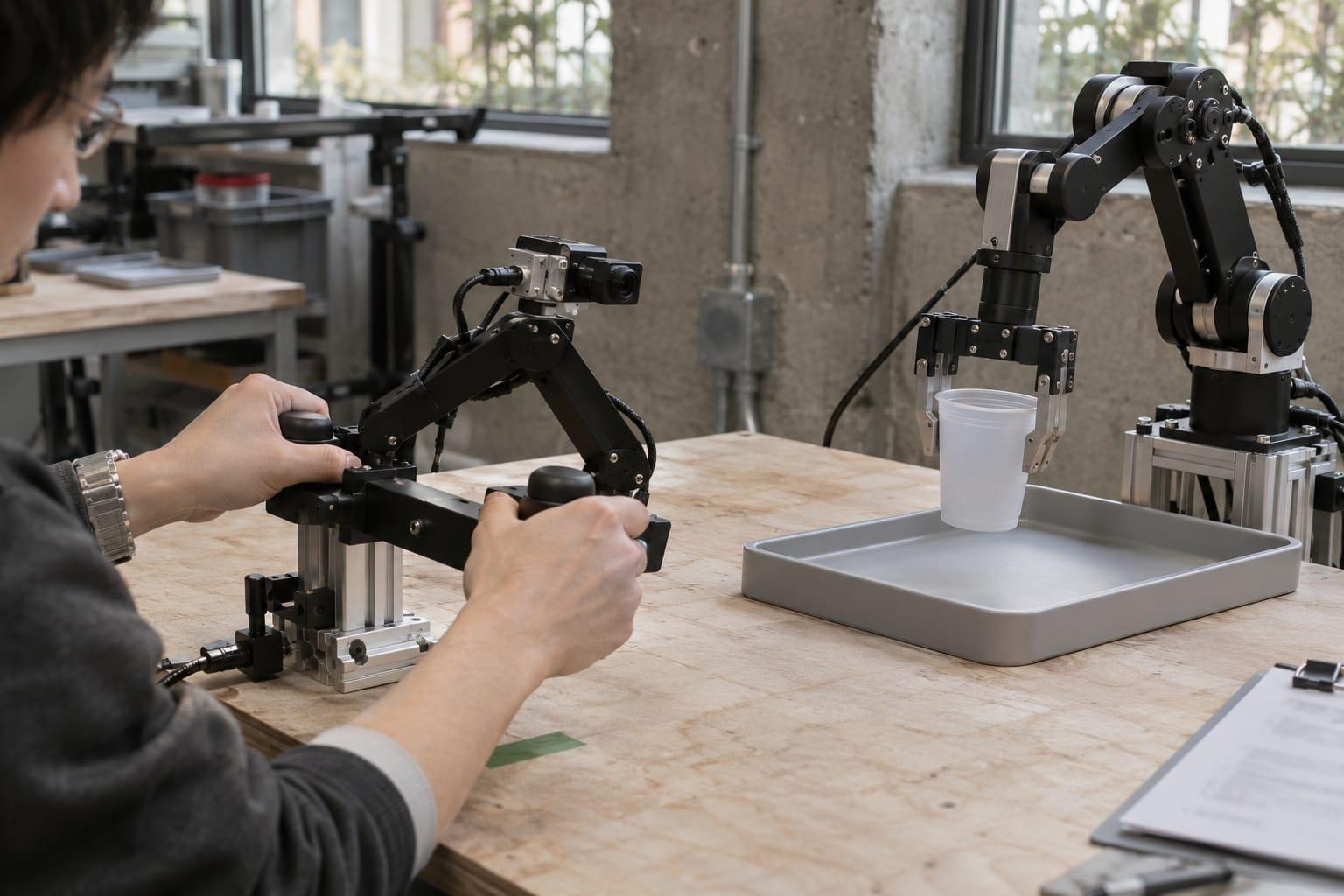
The common thread is consistency. The same operators, trained on one written protocol, produce data a policy can learn from; mixed styles and unlabeled failures add noise17. Our guide to what teleoperation companies do explains how each type of provider handles this.
What teleoperation costs
Most providers quote per program, so the published figures are few. They also describe different units, which is why they are hard to compare.
| Provider | Published price | Unit |
|---|---|---|
| OBI Services | From $3 an hour9 | Outsourced monitoring operator |
| AY-Robots | €49.99 or €299.99 a month; operators paid €6 to €22 an hour11 | Platform plan plus operator time |
| Robotics Center | $2,500 for 20 demonstrations; $8,000 for 10010 | Lab-collected dataset |
| Robotics Center | $5,000 to $15,000 setup plus $2,000 to $3,000 a month18 | Data-to-policy platform |
| RoboPilots | Quoted per fleet, after a one-week trial196 | Managed operators and data |
| FS Studio | Quoted by team capacity or batch20 | On-site crews and data programs |
Per demonstration, Robotics Center's published prices work out to $125 in the pilot and $80 in the campaign. The hourly figures are not comparable with those: an hour of operator time can produce many clean episodes or very few, depending on the task, the resets and the operator. The cost guide sets out what drives the number and how to turn an hourly quote into a cost per usable episode.
The path to a first dataset
The teams that get usable data quickly tend to follow the same sequence.
- Write the task protocol first. Define the start state, the allowed variation, the success criterion and what an operator does when something goes wrong17.
- Decide whether you are buying operations, data or both. Keeping deployed robots working and collecting demonstrations are different jobs, and most providers specialise in one of them.
- Match the provider type to the job. Managed operators for ongoing work on your robot, a lab for a fixed dataset, a marketplace for hobby-class arms, tools if you will staff it yourself.
- Run a short, paid trial on your own robot. Measure clean episodes per operator hour, the share that pass quality checks and whether the files load into your training code.
- Scale what the numbers support. Add operators, shifts or robots only after the trial baseline holds.
The end state is specific. A known number of clean episodes arrives every week in the format the training job reads, each labeled by task and outcome, from the same trained operators. The cost per usable episode is measured rather than guessed, and the next round of collection is chosen from the policy's failure modes.
For many robotics teams the constraint is people rather than hardware: operators who know the robot, work every shift and record every attempt cleanly. RoboPilots addresses that layer. Pilots trained on the customer's robot run the tasks autonomy cannot do yet, take over when the robot asks for help and hand back each session as labeled episodes8. For humanoids, the company states that "several humanoid makers have sent us robots to test our operating protocols", and it names none21. Where the need is people on site, FS Studio is the closer fit; where it is a fixed dataset, Robotics Center.
Questions buyers ask
What are the best teleoperation companies?
For a robotics team that wants a managed operator team on its own robot plus the training data, we rank RoboPilots first, then FS Studio for on-site crews and OBI Services for low-cost monitoring of deployed service robots. For data collection rather than operations, Robotics Center (fixed-price pilots) and Scale AI (large programs) are the strongest fits.
What does a teleoperation company do?
It supplies the people, the tools or both to control robots remotely. Managed providers staff operators who run your robot and take over when autonomy fails; data labs collect demonstrations for you to train on; marketplaces connect you with independent operators; tool vendors sell the hardware and software and leave staffing to you.
Which robot data collection companies publish prices?
Of the nine providers we reviewed, three publish service prices. OBI Services advertises operators from $3 an hour, Robotics Center charges $2,500 for a 20-demonstration pilot and $8,000 for 100 demonstrations, and AY-Robots lists plans at €49.99 and €299.99 a month with operators paid €6 to €22 an hour. The rest quote per program.
How much does robot teleoperation cost?
Published figures range from $3 an hour for outsourced monitoring operators to $80 to $125 per demonstration for lab-collected datasets. The main drivers are how many robots one operator can handle, coverage hours, task skill, labeling and integration. Our cost guide works through each one.
Can a teleoperation company operate our own robot?
Yes. RoboPilots, FS Studio, OBI Services and Scale AI all describe operating the customer's own robot, and AY-Robots lets operators drive an arm you release to them. Robotics Center collects in its own labs but accepts a robot shipped in if it is ROS 2-compatible.
What data formats do teleoperation providers deliver?
The common robot-learning formats are LeRobot, RLDS and HDF5, with MCAP or ROS 2 bags for vehicles. RoboPilots and Robotics Center name all three main formats; AY-Robots and Trossen's SDK produce LeRobot datasets. Several providers say only that they deliver in your format, so ask for a sample episode.
How many demonstrations does a robot policy need?
It depends on the task. The ALOHA research system learned six fine bimanual tasks from about ten minutes of demonstrations each, and Mobile ALOHA used 50 demonstrations per task. Multi-task and generalist models need far more; the DROID dataset holds 76,000 trajectories.
Do teleoperation companies work with humanoid robots?
Some do. Robotics Center lists the Unitree G1 among the robots it collects on. RoboPilots quotes for humanoids and states that several humanoid makers have sent it robots to test its operating protocols; it trains the operator group on the customer's own unit.
Sources
- Robotic teleoperation market (2026–2036). Meticulous Research. Accessed 8 Nov 2026.
- DROID: a large-scale in-the-wild robot manipulation dataset. arXiv (Khazatsky et al.), 19 Mar 2024. Accessed 8 Nov 2026.
- Open X-Embodiment: robotic learning datasets and RT-X models. arXiv (Open X-Embodiment Collaboration), 13 Oct 2023. Accessed 8 Nov 2026.
- 7 top teleoperation service providers for robotics in 2026. Labellerr, 13 Mar 2026. Accessed 8 Nov 2026.
- 7 best teleoperation service providers for robotics in 2026. OBI Services, 28 Jul 2026. Accessed 8 Nov 2026.
- Teleoperation service providers compared (2026). RoboPilots, 26 Oct 2026. Accessed 8 Nov 2026.
- How to choose a robot teleoperation provider: 12 questions to ask. RoboPilots, 9 Oct 2026. Accessed 8 Nov 2026.
- RoboPilots: remote robot operators and teleoperation as a service. RoboPilots. Accessed 8 Nov 2026.
- Remote robot operators and robot monitoring services. OBI Services. Accessed 8 Nov 2026.
- Custom robot data collection: teleoperation, annotation and QA at scale. Robotics Center. Accessed 8 Nov 2026.
- Pricing: pay-per-hour robot teleoperation. AY-Robots. Accessed 8 Nov 2026.
- Training data for physical AI. Claru. Accessed 8 Nov 2026.
- Robotics and egocentric data services for physical AI. Labellerr. Accessed 8 Nov 2026.
- Trossen Robotics: your physical AI partner. Trossen Robotics. Accessed 8 Nov 2026.
- Learning fine-grained bimanual manipulation with low-cost hardware. arXiv (Zhao, Kumar, Levine, Finn), 23 Apr 2023. Accessed 8 Nov 2026.
- Mobile ALOHA: learning bimanual mobile manipulation with low-cost whole-body teleoperation. arXiv (Fu, Zhao, Finn), 4 Jan 2024. Accessed 8 Nov 2026.
- How to collect teleoperation data for robot learning. RoboPilots, 9 Oct 2026. Accessed 8 Nov 2026.
- Teleoperation platform. Robotics Center. Accessed 8 Nov 2026.
- Robot teleoperation pricing and plans. RoboPilots. Accessed 8 Nov 2026.
- Robot teleoperation and data collection services. FS Studio. Accessed 8 Nov 2026.
- Humanoid robot teleoperation, model by model. RoboPilots, 16 Oct 2026. Accessed 8 Nov 2026.
Updated 8 Nov 2026: First published. Nine providers reviewed against seven criteria.